How VoIP Boosts Productivity for Property Managers (and Powers Growth)
60% of calls to property management firms never get picked up, and each of those missed connections represents lost revenue. When your communication is fragmented across disparate channels, it creates a silent barrier to expansion. Adopting VoIP and a centralized inbox allows teams to capture more leads, eliminate the friction of constant phone tag, and increase their door count without needing to hire additional staff.
By LeadSimple Team
Property Management

Ask any property manager where their day actually goes, and you'll hear a version of the same answer: the phone. A prospective owner calls during a showing. A resident texts about a leak while you're mid-email to a vendor. By the time you circle back, three more messages are waiting, and at least one caller has already moved on to the next company on their list.
That constant context-switching is more than an annoyance. By LeadSimple's own count, as many as 60% of calls to property managers go unanswered and every one is a prospective owner, a lease inquiry, or a resident issue that resurfaces later, usually louder. Missed calls like these are a ceiling on growth. When communication is scattered across personal cells, a shared voicemail box, and an inbox nobody fully owns, adding doors just adds chaos.
That's where VoIP comes in.
What VoIP Means for Property Managers
VoIP (Voice over Internet Protocol) simply means your phone system runs over the internet instead of a traditional landline. In practice, that shift unlocks far more than cheaper calls. It's what separates a true property manager phone system from a legacy landline: cloud phone systems for real estate turn the phone from a single device tied to a desk into a flexible tool your whole team can use from anywhere — the office, a unit turnover, or a home office three time zones away.
For a growing property management business, that flexibility matters. Add a line, a number, or a remote leasing agent in minutes, and the system scales with your door count instead of fighting it.
How VoIP Boosts Productivity for Property Managers
The productivity gains from VoIP for property management come from a few connected places. None of them require a bigger team, just a smarter setup.
Answer more of the calls that matter
Missed calls are missed revenue, and they compound the longer they go unaddressed.
Cloud phone systems close that gap with intelligent routing. Ring groups send a call to everyone on a team at once, ring order walks it through your staff until someone picks up, and call trees let callers route themselves to leasing, maintenance, or accounting without a human operator. When a call does slip through, missed-call reporting flags it right away so someone can follow up before the caller gives up.
Keep calls, texts, and emails in one place
Most property management communication tools treat phone, text, and email as three separate systems. Your team pays for that separation in time, whether it's asking around to figure out who last spoke to an owner or re-explaining a maintenance issue a resident already described twice.
A unified inbox solves this by putting every call, text, email, and internal note on a single timeline for each contact, so anyone can pick up a conversation exactly where a teammate left off, with full context and no guesswork.
Scale communication without scaling headcount
This is where cloud phone systems become a genuine growth strategy for a scaling property management business, rather than just a utility. AI Answer Assist can draft replies in seconds based on the conversation, and for text messages it can respond automatically when your team isn't available, while also qualifying inbound leads and turning messages into follow-up tasks, handling the routine work that quietly eats hours. Pair that with automatic call recording for training, compliance, and dispute resolution, plus analytics that track response times and workload, and you have a communication system that lets a lean team manage more doors.
This is the real promise of the right tools for property managers: not doing more work, but needing less of it.
Cut costs and add flexibility
Because VoIP runs over the internet, it strips out the hardware, per-line fees, and maintenance costs of legacy phone systems. You get business numbers on any device, dedicated lines for each team member or office, and the ability to work from anywhere, often for less than you're paying now. For teams watching every dollar as they grow, that combination of lower cost and more capability is one of the simplest ways to improve customer communication with VoIP without adding headcount.
Turning Communication into a Growth Lever
Here's the shift worth internalizing, and it's one of the more overlooked property management growth strategies: communication isn't a back-office cost, it's the front door. The speed and consistency of your responses shape whether an owner signs, whether a resident renews, and whether your reputation travels by referral or by review. Property managers who scale well treat that front door as infrastructure, not an interruption. This frees their team's time for relationships, retention, and revenue instead of phone tag.
Where LeadSimple's Phone + Inbox Fits
There are several ways to build a cloud phone setup, from stitching together standalone VoIP and texting tools to adopting an all-in-one platform. The right choice depends on your size, your existing stack, and how much you value having everything in one system.
Here's a quick way to think about it:
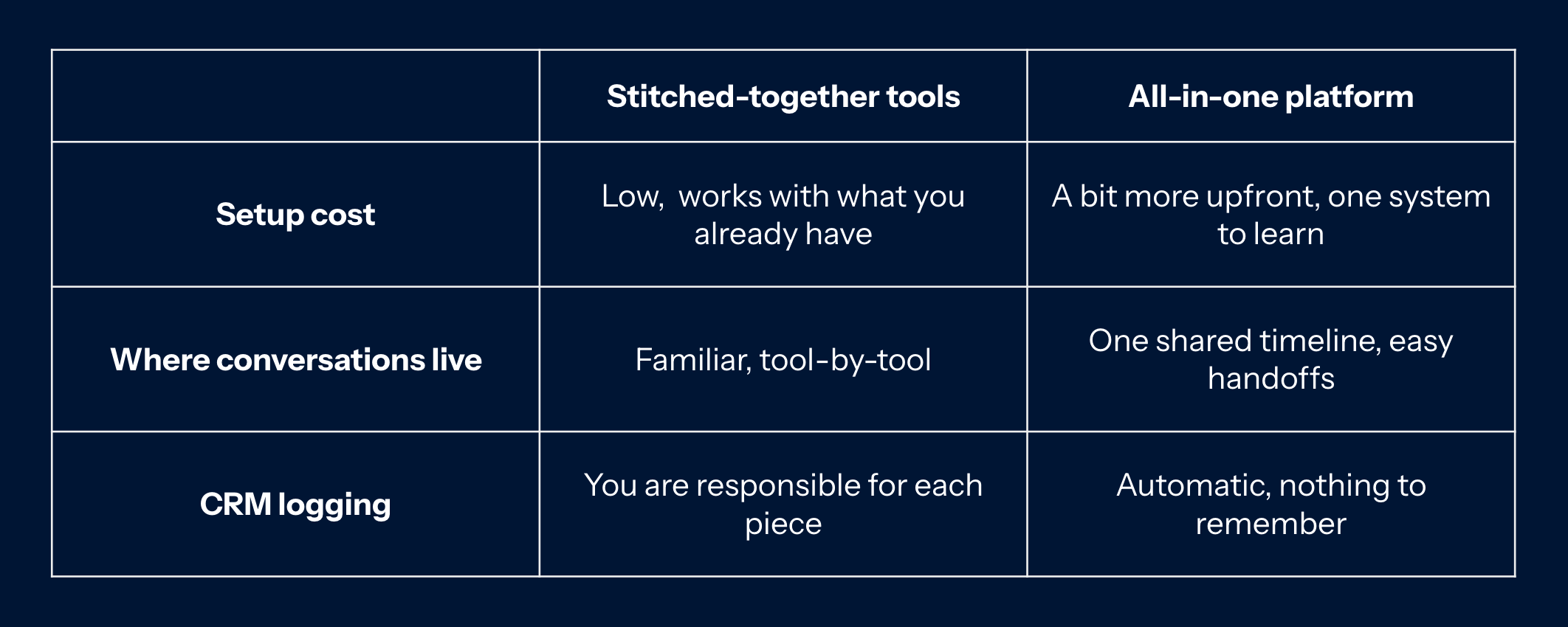
Both paths work well — it really comes down to whether you'd rather keep the flexibility of separate best-in-class tools, or trade a little of that flexibility for everything living in one place.
LeadSimple's Phone + Inbox is one path worth knowing about, particularly because it was built specifically for property managers rather than adapted from a general business phone product. It brings VoIP calling, SMS and MMS, and email into that single timeline, and layers on AI-assisted replies and lead qualification right out of the box. It runs as a standalone product, so you don't need to adopt LeadSimple's CRM to get started.
For teams that do use LeadSimple's CRM, pairing the two goes further: every touchpoint logs automatically and can trigger workflows straight from a conversation, removing a lot of the seams where work usually falls through.
The point isn't the brand. It's the principle: the closer your phone, texts, and workflows sit to one another, the less time your team loses moving between them.
A Simple Next Step
You don't need to overhaul everything at once. Start with a quick audit of your own numbers:
- How many inbound calls actually get answered — not sent to voicemail?
- How many channels does a single owner conversation touch (call, text, email) before it's resolved?
- How much time does your team spend just tracking people down?
That picture alone usually makes the case.
From there, if you want to see what a purpose-built system looks like in practice, you can schedule a demo of LeadSimple's Phone + Inbox. Scaling your doors gets a lot easier when your communication scales with you.